
The First Month Verdict: Which EIHL Teams Have Us Worried?

All stats correct 15/10/2026
The first few weeks of a hockey season can change everything. One big win creates excitement. A couple of defeats can leave supporters questioning the summer’s recruitment.
But let’s be honest, the league table rarely tells the whole story.
At Door 14 Hockey, we’re looking beyond the standings. We’re considering the EIHL league campaign and the Challenge Cup. We’re also revisiting the expectations we discussed before the season began.
Which teams are exceeding expectations and which clubs have genuine reasons to worry?
This is our first monthly verdict. It isn’t a prediction of where every team will finish in April (we did that in episode 157 of the podcast). This is more of an honest assessment of what we’ve seen so far and the potential warning signs we’re watching already.
Manchester Storm: the homecoming comes with pressure
Manchester Storm’s return to the AO Arena was always going to be one of the biggest stories of the season.
After more than two decades away, the club returned to its former home in September. The excitement was clear before the competitive season even began. More than 11,000 fans attended the pre-season game against Sheffield, setting a new attendance record for an Elite League (pre-season) fixture.
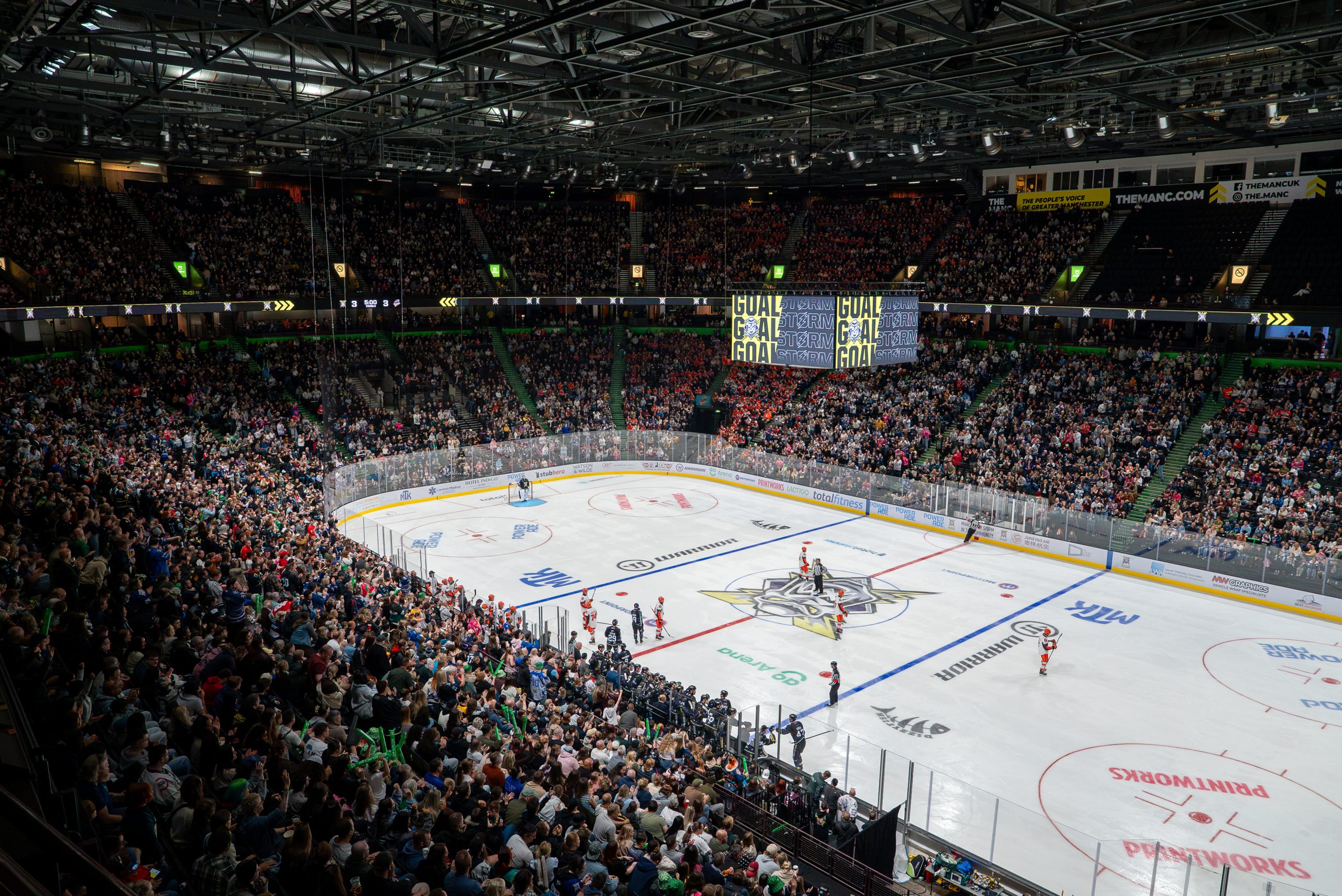
That is a remarkable achievement for the club to build on.
But with a massive crowd comes massive expectation
Manchester reached the Playoff Finals Weekend for the first time in the club’s history last season. The return to the AO Arena offered an opportunity to build on that progress, both on and off the ice.
The early league results have raised questions. Six points from six games, with ten goals scored and fifteen conceded, is a modest return. It’s not a crisis, but it’s also not the start that will silence every concern.
The key question is whether Manchester can turn the excitement surrounding their homecoming into consistent performances.
The real test over the next month is whether they can actually convert those chances, tighten up the back line, and prove that this summer’s recruitment works in practice, not just on paper
At the same time, it’s unfair to judge the success of the homecoming purely by league points. A club can succeed in attracting supporters and building momentum while the team is still finding its rhythm.
The homecoming has created the opportunity. Now Manchester must make the hockey match the occasion.
The next month will tell us much more about whether the Storm can turn that opportunity into sustained progress.
The Takeaway: The club has knocked it out of the park off the ice. Now the pressure is on to mirror that consistency on it.
The pre-season predictions: what did we get right?
Before the season began, we discussed several clubs whose campaigns looked particularly interesting. Now it’s time to revisit those conversations.
Belfast Giants: built to challenge again?
Our pre-season discussion wasn’t a guarantee that Belfast would win another title. Instead, we felt their summer signings had strengthened a core capable of challenging again.
The Giants entered the season as defending league champions, meaning every other team in the building is going to measure themselves against them. However, Belfast must prove they can maintain that level over another long campaign.
Their early Challenge Cup form has been encouraging. That said, their league sample remains small, so it’s too early to draw any real conclusions about their title defence.
The recruitment looks designed to keep Belfast competitive. The roster looks built for another run, but as any hockey fan knows, paper depth doesn’t hand you a trophy. Staying healthy and surviving the winter grind will be the real test.
Our View: The roster looks built for another title run, but the league grind needs time to show if they have the depth to sustain it.
Sheffield Steelers: when is progress enough?
Sheffield presents a different challenge.
In our pre-season discussion, we highlighted the pressure on the Steelers to achieve silverware. After several seasons without a trophy, simply being competitive may not be enough.
That pressure falls on head coach Aaron Fox. Sheffield are a club with high expectations, and the focus will be on whether this group can deliver come the end of the season.
Their early Challenge Cup position has been encouraging. However, the league campaign has produced a more mixed return.
A strong group-stage position is valuable, but it isn’t a trophy. Sheffield must carry that form into the league and show they can produce consistent performances against the strongest opposition.
Their 5–0 league win over Glasgow showed what they can do when things click. The next step is to make those performances a regular feature.
The Bottom Line: Aaron Fox has a squad capable of winning it all, but early cup form won’t satisfy a fan base demanding silverware.
Fife Flyers: the points that could matter in April
Our pre-season conversation about Fife was shaped by the ownership uncertainty surrounding the club last season. This campaign offered an opportunity to move forward, rebuild confidence and show that the Flyers could compete.

So far, there have been VERY positive signs.
The 10–2 victory over Guildford was an extraordinary result, but it shouldn’t overshadow something potentially just as important. Fife’s two overtime victories against the Sheffield
Steelers could prove valuable when the league table starts to take shape later in the season.
Taking points from a team expected to challenge for silverware matters. In a closely contested league, every point can influence the final standings.
Overtime victories also show that Fife have found ways to get over the line in tight games. That is a useful quality, although we’ll need a larger sample before deciding how consistently they can do it.
The challenge now is to build on those results. Fife followed their big win over Guildford with a 3–2 defeat to Nottingham. That contrast shows why one headline scoreline shouldn’t define an entire campaign.
The 10–2 win grabbed the headlines. The two overtime wins over Sheffield could prove just as important when the season reaches the final stages.
Fife don’t need to win every game convincingly to have a successful season. Instead, they need to keep taking points from strong opponents and make their good performances count.
Fife Flyers: The Verdict: Those gritty overtime wins against Sheffield are a massive statement. If they can find consistency, they’ll surprise a lot of people.
The warning signs: which teams should be concerned?
Although we focused on Manchester, Belfast, Sheffield and Fife during our preseason episode, the rest of the league deserves the same scrutiny.
The league and Challenge Cup sometimes tell different stories. That’s why we need to consider both competitions before reaching a verdict.

Glasgow Clan: the alarm bells are ringing
Glasgow’s league start has been extremely difficult.
Seven defeats from seven games, no league points and 27 goals conceded make for grim reading. Their 5–0 defeat to Sheffield was followed by a 6–2 loss to Guildford.
The club then parted ways with head coach Mike Sirant on 12 October. Assistant coach Steven Birnstill and the supporting staff took over on an interim basis while the club explored its options.
To pull the trigger on a coaching change this early in the year is a massive statement.
Look at the Challenge Cup, though, and the picture gets a lot more complicated. Glasgow have been more competitive in that competition, collecting seven points from six games after their latest match.
Their 6–5 overtime defeat to Dundee on 14 October added another twist. Glasgow scored five goals, but still couldn’t secure the win. Dundee, meanwhile, earned valuable points after a difficult start of their own.
The question now is whether Glasgow can turn competitive performances into league results. Can the coaching change help them become more consistent? And can they tighten up defensively before the gap becomes harder to close?
The Alarm Bells: A coaching change this early is a massive gamble. The cup form is respectable, but the league record means the next month is do-or-die.
Dundee Stars: defensive problems need answers
Dundee have also struggled to find consistency.
In the early league snapshot, the Stars had one point from four games, with eight goals scored and nineteen conceded. Their Challenge Cup campaign had also been difficult.
The 3–0 defeat to Cardiff and the 8–2 loss to Coventry raised questions about Dundee’s defensive lines and their ability to keep games competitive.
That said, the 6–5 overtime victory over Glasgow on 14 October was exactly the lifeline they needed. Dundee scored six goals and found a way to win a tight game, despite their earlier struggles.
That result doesn’t erase the concerns, but it does give the Stars something to build on.
For Dundee, the immediate priority is to improve defensively and find a more consistent route to scoring.
The Reality: One overtime win doesn’t fix a leaking defensive line. The next fortnight will prove if they’ve truly turned a corner.
Guildford Flames: scoring isn’t the problem
Guildford have been one of the most difficult teams to assess.
Their early league record showed nineteen goals scored and nineteen conceded in four games. They then suffered that extraordinary 10–2 defeat to Fife before responding with a 6–2 victory over Glasgow.
The Flames are clearly built to score in bunches. The problem is, they’re letting opponents do the exact same thing at the other end.
The Challenge Cup has raised similar questions about their balance between attack and defence. Guildford can be dangerous going forward, but they need to find greater consistency at the other end.
A high-scoring team can be entertaining, but it will struggle to challenge consistently if it keeps giving opponents too much space and too many opportunities to score.
The Balance: They are easily one of the most entertaining watches in the league, but they won’t compete for trophies until they fix the leaks at the back.
The middle ground: Cardiff, Coventry and Nottingham
But what about the remaining three teams?
Cardiff Devils: setting the early standard
Cardiff made an excellent start to the league campaign, winning their opening four games and conceding just three goals.
That defensive record stands out and suggests a team that has started with control and discipline.
The Challenge Cup has been a bit more of a bumpy ride, though. That contrast is a great reminder that early success in one competition doesn’t automatically carry over to the next.
Cardiff need to show that their strong league start can continue against tougher opposition. The early signs are encouraging, but the season is still young.
Setting the standard: Their defensive control has been an absolute masterclass so far. The real test is maintaining that lockdown structure as the winter schedule gets heavier.

Coventry Blaze: goals and momentum
Coventry have also made a strong league start.
Their 8–2 win over Dundee highlighted their attacking potential. Across their first five league games, they have scored eighteen goals and conceded eight.
Those numbers look great on paper. Mind you, their Challenge Cup campaign has been a much tougher grind, meaning the overall picture isn’t completely clear-cut just yet.
The question is can Coventry carry their league form into the Cup and sustain their scoring against stronger opponents?
Momentum test: They are scoring for fun in the league right now, but they need to replicate that attacking spark in the cup before they can be called true contenders
Nottingham Panthers: promising, but too early to judge
Nottingham’s early league sample was much smaller than most of their rivals.
They had played only two league games in the initial snapshot, winning both and scoring eight goals while conceding three. Their Challenge Cup campaign has provided a different test.
Those numbers look great on paper. Mind you, their Challenge Cup campaign has been a much tougher grind, meaning the overall picture isn’t completely clear-cut just yet.
We need to see how they perform across a longer run of fixtures. Until then, declaring them contenders or questioning their potential would be premature.
Too early to call: Two wins from two games is a flyer of a start, but we need a much larger league sample size before mapping out their ceiling.
October is just the starting line
The first month has shown us that the league table rarely tells the whole story.
Manchester’s homecoming is about more than results. Belfast’s Challenge Cup form doesn’t yet prove another league title is coming. Sheffield’s Cup position doesn’t end the debate about silverware.
At the same time, Fife’s overtime wins could matter much more in April than they seem in October. Glasgow and Dundee both have problems to solve, but Dundee’s latest victory shows how quickly a difficult story can begin to change.
That’s why we want to return to this every month. We’ll revisit our earlier judgements and admit when we’ve got things wrong.
October gives us the questions. The coming months will give us the answers.
Now it’s over to you.
Which EIHL team has impressed you most so far? And which club should be most concerned about its start to the season?
Are we worrying too early about any of these teams, or have we missed something important?
Let us know.
We might revisit your arguments in next month’s verdict.
You must be logged in to post a comment.